The Hidden Half of the Universe Was Always There
When the James Webb Space Telescope began peering into the cosmos's earliest eons, it delivered discovery after discovery. But astronomers realized they were looking at only half the story: thousands of faint galaxies lay beneath the image noise, invisible unless researchers spent months stacking exposures.
Then came ASTERIS. [1]
In a paper published in Science this year, researchers led by Yuduo Guo at Tsinghua University unveiled an astronomical self-supervised transformer-based denoising network that does what seems to defy physics: it reveals galaxies fainter than what the telescope actually recorded, without fabricating false signals. [2]
"For a proof of concept, ASTERIS has already more than doubled the number of distant galaxies detected in a set of images taken by the James Webb Space Telescope." [3]
How It Works
The challenge is elegantly simple. In any cosmic image, fainter celestial sources vastly outnumber bright ones—but noise obscures them. Astronomers already knew the solution: expose for longer. Stack 168 exposures instead of eight, and you'll see faint objects. But JWST time costs millions.
ASTERIS takes a different approach. It uses machine learning trained on astronomical data to distinguish between real faint sources and noise artifacts. The team validated ruthlessly: they injected fake signals to verify the network could spot them; trained on limited data sets to test robustness; and ultimately verified results against real deep-exposure images. [4] The AI system performs comparably to a 21-fold increase in exposure time—using the same eight-exposure datasets. [5]
What's crucial: this isn't hallucination. The validation protocol convinced even skeptical observers. [6]
Why This Matters for Cosmology
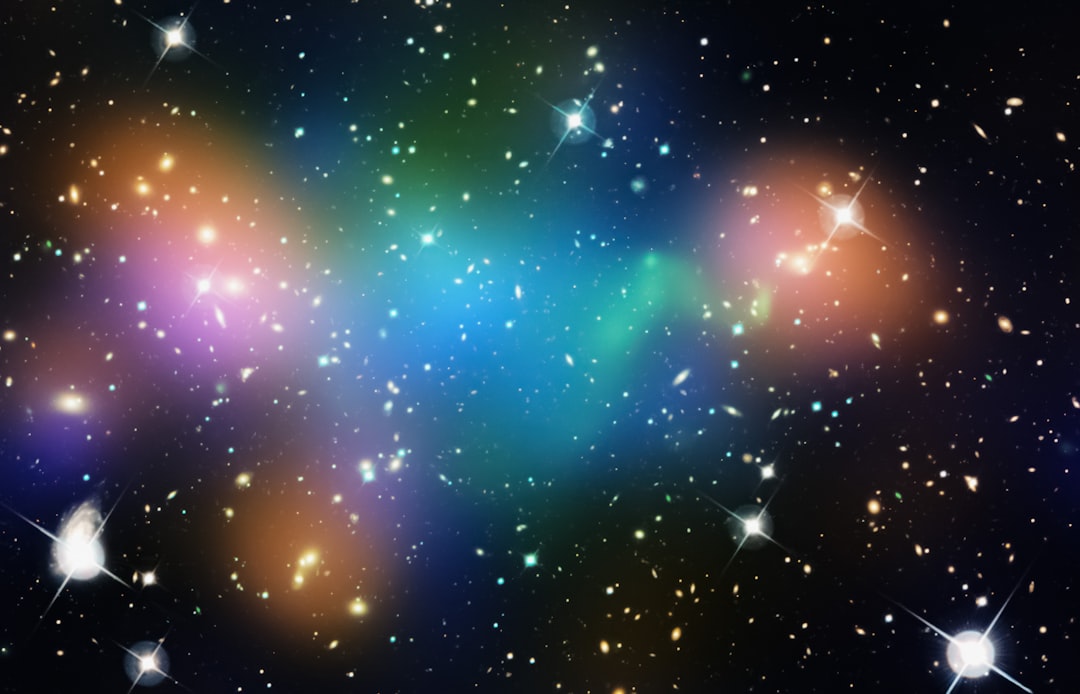
The implications ripple through decades of assumptions about galaxy formation. Using data from NASA's James Webb Space Telescope (JWST), scientists, including astronomer Bahram Mobasher at UC Riverside, have made one of the most detailed, high-resolution maps of dark matter distribution ever produced. [7]
But ASTERIS enables an entirely new tier of discovery. The network is already being applied to additional Webb datasets and even ground-based telescopes like Subaru. [8] Early results suggest thousands of additional early galaxies exist—galaxies we didn't know were invisible to us.
This compounds recent shocks from Webb itself. Using data from NASA's James Webb Space Telescope, astronomers from the Center for Astrophysics | Harvard & Smithsonian (CfA) have revealed the universe's most mysterious distant objects, known as little red dots, may actually be gigantic, short-lived stars. The findings offer a direct glimpse into how the universe's first supermassive black holes may have formed, marking a breakthrough in scientists' understanding of the early cosmos. [9]
The Telescope Collaboration
Meanwhile, Webb and Hubble are proving that partnership outperforms either alone. NASA's Webb and Hubble Space Telescopes have teamed up to capture new views of Saturn, revealing the planet in strikingly different ways. Observing in complementary wavelengths of light, the two space observatories provide scientists with a richer, more layered understanding of the gas giant's atmosphere. Both sense sunlight reflected from Saturn's banded clouds and hazes, but where Hubble reveals subtle color variations across the planet, Webb's infrared view senses clouds and chemicals at many different depths in the atmosphere, from the deep clouds to the tenuous upper atmosphere. [10]
In February, astronomers have charted the vertical structure of Uranus's upper atmosphere, revealing how temperature and electrically charged particles change with altitude across the planet. An international research team used the James Webb Space Telescope and its NIRSpec instrument to monitor Uranus for nearly one full rotation. By capturing faint molecular emissions high above the cloud tops, the scientists gained new insight into how ice giant planets move and manage energy in their upper layers. [11]
When Luck Becomes Data
Hubble also delivered serendipity. In an incredibly lucky cosmic accident, NASA's Hubble Space Telescope captured a comet breaking apart in real time—something astronomers have long tried and failed to observe. Comet C/2025 K1 (ATLAS) fragmented mid-observation in March 2026—the first time astronomers directly witnessed cometary disruption. [12]
And Hubble's own aging instruments are finding new life through AI. Astronomers employed artificial intelligence (AI) to analyze nearly 100 million image cutouts from the Hubble Legacy Archive in just 2.5 days. This initiative, conducted on January 27, 2026, led to the identification of approximately 1,400 anomalous objects, with over 800 being previously undocumented. [13]
The Bigger Picture
We're witnessing the shift from telescope-as-observer to telescope-as-data-source. Webb generates terabytes of imagery that won't be fully analyzed for decades—or until AI catches up. ASTERIS proves the investment may finally be paying dividends.
The early universe just got vastly more populated. And we're only beginning to count.
Sources & References
[1] https://science.nasa.gov/mission/webb/
[11] https://www.sciencedaily.com/releases/2026/02/260221000303.htm
[12] https://www.sciencedaily.com/releases/2026/03/260321012648.htm