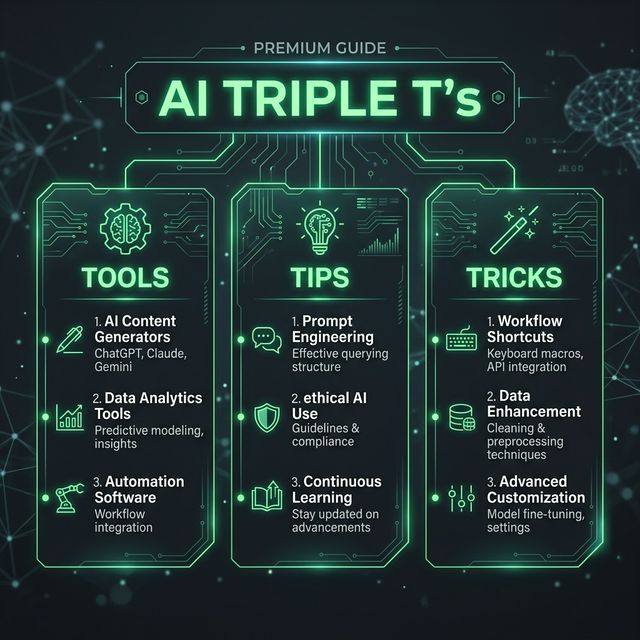
AI Triple T's: AI for Health, Wellness, and Longevity
Tools, Tips & Tricks for Your Best Self
Welcome to 2026: the year longevity went mainstream. While previous wellness trends cycled through fads, AI-powered health tech is fundamentally shifting how we monitor, understand, and optimize our bodies. This isn't hype—major players like Human Longevity are launching AI-powered apps that combine artificial intelligence with longitudinal health data to help identify patterns over time. The infrastructure is here. Now, let's master it.
5 Tools You Should Know
1. Longevity Mirror (NuraLogix)
The most elegant new entry to health tech. The Longevity Mirror uses a simple camera paired with AI to analyze more than 100 wellness indicators, and using advanced AI trained on hundreds of thousands of patient records, estimates health risks up to 20 years into the future.
Why It Matters: Developed by Canadian health-tech company NuraLogix, the Longevity Mirror uses artificial intelligence and Transdermal Optical Imaging (TOI) to assess subtle variations in facial blood flow. In under 30 seconds, the device generates a comprehensive Longevity Index. No wearables. No friction. Just a morning glance that gives you predictive insight.
The Hook: The Longevity Mirror includes an AI Health Assistant that translates insights into everyday advice: how to improve sleep, manage stress, adjust activity or tweak nutrition. It bridges the gap between raw data and actionable behavior.
2. Longevity AI (Florence)
Purpose-built for health professionals and precision clinics. Upload any lab PDF, track biomarkers, and deliver personalized health plans. The platform offers a "Book About You" — a personalized, client-ready report that translates health data into longevity insights and a clear, actionable plan for optimizing health.
Why It Matters: Embedded across the platform, Florence helps you move faster, see clearer, and deliver better care. This is the tool that turns scattered health data into a narrative your body can follow.
Best For: Clinicians, coaches, and serious biohackers who want to synthesize multiple data streams (genetics, bloodwork, wearable data, behavior) into one coherent plan.
3. Human Longevity Mobile App
The app combines artificial intelligence with longitudinal health data to help identify patterns over time and provide a deeper understanding of health beyond one-time reports. Designed to make complex medical information easier to access and interpret, the platform enables members to engage with their health information between clinical visits. The platform transforms traditional Executive Health from periodic evaluations into a continuous, AI-driven experience.
Why It Matters: By integrating artificial intelligence with longitudinal health data, the app personalizes health risk management and supports ongoing monitoring rather than one-time assessment.
Real Value: This shifts healthcare from episodic (annual checkups) to continuous. You're not waiting for results; you're watching trends unfold in real time.
4. Bevel (AI Health Companion)
Bevel is the AI health companion that turns your data into personalized insights and recommendations across sleep, fitness, nutrition, and more.
Why It Matters: Know when to push, when to pause, and when you're ready to perform, backed by real-time metrics and biomarkers. Improve your sleep by understanding patterns, identifying disruptions, and building habits that support deeper rest. Understand how much strain you're under, how it affects your body, and how to adjust for progress without burnout.
Unique Angle: Bevel doesn't just report metrics—it contextualizes them. It tells you why your HRV dropped, what your late-afternoon caffeine did to your sleep, and how your salmon dinner timing affected your recovery.
5. AI-Driven Wearable Ecosystems (Oura, Whoop, Ultrahuman)
Brands like Oura, Ultrahuman, Whoop, Apple and Garmin spent 2025 turning rings, watches and sensors into broader systems built around stress, sleep, biomarkers and AI guidance. Hardware updates still mattered, but most of the action happened in software, partnerships and how data is being used in real-world settings.
Why It Matters: They are evolving into integrated, AI-powered bio-monitoring systems that deliver continuous physiological insight, predictive analytics, and real-time behavioral optimization. The market is shifting toward devices that do more than measure steps or heart rate—they interpret biological signals, forecast health trajectories, and empower individuals to extend both lifespan and healthspan.
The Shift: Stress and recovery became the organizing logic for several flagship products. Oura introduced Cumulative Stress, a long-term biomarker that blends heart response, sleep continuity, temperature variation and movement to show how the body accumulates and clears stress over roughly a month instead of a single day.
Pro Tips & Tricks: How to Actually Use These Tools
Pro Tip #1: Use Longitudinal Data, Not Single Snapshots
One blood glucose reading means nothing. In 2026 and beyond, wearable devices are expected to combine glucose variability data with sleep metrics, stress indicators, and physical activity patterns. This holistic metabolic intelligence enables users to understand how dietary choices affect energy stability, fat oxidation efficiency, and cognitive clarity.
Action: Set a 30-day tracking window before drawing conclusions. Use Bevel or Human Longevity App to watch patterns emerge over 4 weeks, not 4 days.
Pro Tip #2: Triangulate Data Across Multiple Sources
By leveraging biomarkers rather than social data as a method of personalization, clubs can limit the amount of bias being introduced into the predictive models and output, addressing members' specific needs or desires in ways that were never possible before.
Action: Don't trust one wearable or one AI app. Cross-reference your ring's sleep data with your mattress monitor, your glucose readings with your activity patterns, your HRV with your calendar (were you stressed that day?). AI works best when it has competing signals.
Pro Tip #3: Let AI Adapt Your Protocol, Not the Other Way Around
Wellness coaching based on real-time data uses biofeedback to adjust health coaching or wellness programs based on actual behavior and health changes. Continuous feedback loop: Instead of waiting for the next appointment, clients can receive actionable insights and recommendations about their health whenever they need them. This shift towards real-time monitoring not only helps clients track their progress but also allows clinics to offer more dynamic and responsive services, improving client engagement and satisfaction.
Action: If your wearable says you're deep in parasympathetic mode (well-recovered), do the hard workout. If it says you're stressed and poorly recovered, do mobility work instead. Stop following generic schedules. Let AI coach you based on your actual state today.
Real-World Use Cases You Can Start Right Now
Use Case #1: The Metabolic Reset (2-3 Weeks)
- Start a continuous glucose monitor (Dexcom or equivalent) + wearable ring (Oura, Ultrahuman).
- Track your baseline for 5 days: sleep, stress, activity, glucose response to meals.
- Use Longevity AI or Bevel to identify your biggest metabolic stressor (late-night carbs? inconsistent sleep? caffeine timing?).
- Change one variable for 7 days (e.g., stop eating 2 hours before bed).
- Watch your glucose variability drop, sleep quality improve, HRV stabilize.
Expected Outcome: People are shifting toward routines designed to improve healthspan, not just life span, focusing on mitochondrial support, inflammation reduction, stress resilience and hormone balance through simple daily habits.
Use Case #2: The Longevity Mirror Morning Ritual (Daily)
- Stand in front of your Longevity Mirror each morning (yes, it should be in your bathroom).
- Check your Longevity Index and physiological age drift.
- Note any deviations from your baseline (stress markers spiking? recovery declining?).
- Let the AI Health Assistant guide the day: "Your stress markers are elevated. Prioritize 10 minutes of breathwork this morning."
- Repeat. Track weekly trends.
Expected Outcome: An integrated AI Health Assistant converts raw analytics into tailored lifestyle recommendations — guiding users toward improved sleep quality, optimized stress management, refined nutrition habits, and balanced fitness routines.
Use Case #3: The Wearable + Labs Integration (Monthly)
- Sync your ring, watch, or health app (Bevel, Human Longevity App) with a quarterly bloodwork panel.
- Use Longevity AI to correlate your wearable trends with biomarker shifts.
- Example: Your HRV has been declining for 3 weeks → bloodwork shows rising inflammation markers → adjust diet, increase sleep, reduce training intensity.
- Repeat quarterly. Watch your biological age improve.
Expected Outcome: In 2026, consumers are prioritizing healthspan over lifespan, focusing on energy, mobility, cognitive clarity, and a body that responds to training and nutrition. Frustrated with traditional sick-care models, they seek providers who track labs for optimal ranges, monitor early warning signs, and deliver personalized, proactive protocols.
The Real Play: Integration, Not Isolation
Longevity technology is moving toward an ecosystem approach where metabolic, cardiovascular, and neurological signals are analyzed collectively. This integration marks a pivotal advancement in personalized longevity strategy.
The tools above don't live in silos. The smartest users are building stacks: Longevity is a leading health motivation, cited by 33.2% of respondents, alongside overall fitness at 46.4%. More than a third of people are actively prioritizing longevity now. You're not alone.
But here's what separates signal from noise: The best use case isn't one tool. It's how you connect them. Your ring feeds your app. Your app correlates that data with your labs. Your labs inform your AI coach. Your AI coach adjusts your protocol. That feedback loop is where the magic happens.
Longevity Tech at CES 2026 demonstrated a significant shift from mere health metric measurement to proactive care aimed at improving and extending human lives. Withings debuted its Body Scan 2, hailed as "the world's first science-backed longevity station," capable of tracking over 60 biomarkers and assessing health trajectory.
You have the tools. The infrastructure exists. Now it's execution.
Bottom Line
AI for health isn't coming—it's here. Wellness becomes hyper-personal and data-driven: Think biomarker-based nutrition and AI wellness coaches. 2026 marks a turning point for personalized wellness, thanks to AI-driven analytics, at-home biomarker tests, and devices that track more than just steps or sleep.
Start with one tool that fits your life (a mirror, a ring, or an app). Master it for 30 days. Add a second layer. Build your stack deliberately. Let AI guide, but you decide the direction.
That's not biohacking. That's intelligence applied to the thing you care about most: how long you live, and how well you live it.