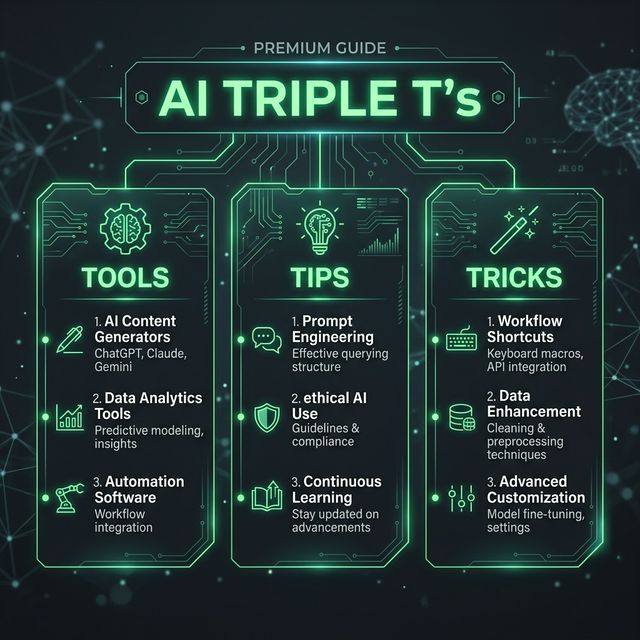
AI Triple T's: Tools, Tips & Tricks for Personal Finance and Investment Analysis
The landscape of AI-powered personal finance has shifted dramatically. In 2026, integration is the differentiator, and the tools that work best are those that connect your entire financial picture rather than solving isolated problems.
The Top 5 Tools Reshaping Personal Finance
1. Origin: The Integrated Command Center
Origin is an all-in-one financial management platform that combines budgeting, investing insights, financial advice, and forecasting in a single app. What sets Origin apart is its ability to connect all aspects of a user's financial life and analyze them together. Instead of treating budgeting, investing, and planning as separate problems, the platform builds a unified financial picture.
Unique Value Proposition: Origin provides full-context financial reasoning across domains (spending, investing, taxes, retirement). If you ask "Should I increase my 401(k) contribution?" it can evaluate cash flow, debt obligations, tax impact, and long-term projections together.
Best For: Investors who juggle multiple financial accounts and need sophisticated scenario analysis without hiring a traditional advisor.
2. Wealthfront: Automated Portfolio Excellence at Scale
Wealthfront is NerdWallet's pick for the best robo-advisor for portfolio options, thanks to its blend of automated investment portfolios and DIY stock investing portfolios, its wide variety of account options, excellent tax strategy and low management fee.
Unique Value Proposition: Platforms like Wealthfront use AI to manage your investments. They handle asset allocation, rebalancing, tax-loss harvesting, and dividend reinvestment — all for 0–0.25% annually.
Best For: Hands-off investors seeking professional-grade portfolio management without the high fees of traditional advisors.
3. PortfolioPilot: Scenario-Driven Risk Analysis
PortfolioPilot's 360° portfolio management platform can help you make better investment decisions by automatically recommending adjustments on your portfolio to hedge against risks or capture opportunities. It provides personalized suggestions based on your current portfolio, expected returns, dividends, tax impact, risk preferences, goals, and downside protection.
Unique Value Proposition: You can stress-test your portfolio against any scenario - from inflation shocks to geopolitical events.
Best For: Risk-conscious investors who want to model "what-if" scenarios before market volatility hits.
4. Magnifi: Natural Language Investment Research
Magnifi allows you to ask complex investment questions in plain English, removing the need to wrestle with financial jargon. The platform excels at natural language search and beginner-friendly portfolio analysis, making it ideal for DIY investors who want professional-grade insights without the intimidation factor.
Unique Value Proposition: No financial jargon required. Ask natural questions and get actionable insights.
Best For: Self-directed investors new to financial analysis who want research without technical barriers.
5. Robinhood Strategies: Context-Aware AI Guidance
Robinhood counts 250,000 customers paying on average $250 annually to use its Strategies, an AI tool guided by human advisors. Earlier AI tools simply slotted customers into one of 20 or so baskets of ETFs based on a questionnaire, but this new offering can account for far more scenarios. For instance, it can provide guidance to someone who has the bulk of their wealth tied to stock options, or is looking to build a portfolio that accounts for their plans to buy a home.
Unique Value Proposition: Hybrid approach combining AI analysis with human advisor oversight for complex wealth scenarios.
Best For: Investors with non-traditional assets (stock options, RSUs, concentrated positions) who need context-aware guidance.
Pro Tips: Make AI Work Harder for Your Money
Pro Tip #1: Layer Your Tools by Function, Not by Account
Most investors mistakenly try to do everything in one app. The smarter approach: Use tools with contextual awareness. When an AI tool understands your income, spending, investments, and liabilities together, it can offer guidance that feels closer to financial coaching than basic software.
Specific approach:
- Use Origin (or similar) as your unified data layer — connect all accounts here
- Use Wealthfront or PortfolioPilot as your portfolio execution engine — let automation handle rebalancing
- Use Magnifi for research and due diligence — explore ideas before committing capital
This separation prevents analysis paralysis while maintaining context.
Pro Tip #2: Deploy Pattern Detection Before Tax Season
One of the most useful applications of AI in personal finance is pattern detection. AI systems can analyze months or years of financial transactions and identify trends that are easy to miss manually.
Actional tactic: By October, run your full-year spending data through AI tools to:
- Identify tax-loss harvesting opportunities before year-end (not in January)
- Flag unexpected spending spikes that may correlate with life changes
- Model Q4 cash flow to optimize Roth conversions or charitable contributions
AI identifies tax-saving opportunities in real-time: tax-loss harvesting, optimal Roth conversion amounts, charitable giving strategies, and asset location between taxable and tax-advantaged accounts. Wealthfront claims their AI tax-loss harvesting adds 1–2% in annual after-tax returns.
Pro Tip #3: Use Scenario Analysis to Separate Signal from Noise
Market volatility triggers emotion. AI tools can provide scenario analysis, allowing portfolio managers to evaluate the impact of different market conditions on their portfolios. By simulating various scenarios, managers can assess the resilience of their portfolios and make informed decisions to mitigate potential losses or take advantage of market opportunities.
Tactical move: Monthly, run 2-3 stress tests through PortfolioPilot:
- 20% market correction
- 5% interest rate spike
- Sector-specific shock (tech, energy, finance)
If your portfolio survives these scenarios, market headlines become noise, not reasons to panic-sell.
Two Immediately Actionable Use Cases
Use Case #1: The "Tax Alpha Audit" (30 Minutes, Immediate Impact)
Scenario: You have $200K spread across 3 brokerages, a 401(k), and taxable accounts. You've never optimized for taxes.
The Play:
- Connect all accounts to Origin (or similar unified platform)
- Run a full-year tax report focusing on:
- Positions with unrealized losses
- Overlapping holdings across accounts (redundant tax inefficiency)
- Asset location mismatches (bonds in taxable accounts, stocks in retirement accounts)
- Use Wealthfront's tax-loss harvesting calculator to model Q4 moves
- Action: Implement 2-3 trades before Dec 31st
Expected outcome: Most robo-advisors charge 0.25-0.50% annually, compared to 1.0% or more for human financial advisors. Over a 30-year investment horizon, that fee difference compounds enormously. On a $500,000 portfolio earning 7% annually, paying 0.25% instead of 1.0% saves approximately $180,000 in fees over three decades. Tax optimization can add 1-2% annually, equivalent to earning more without taking additional risk.
Use Case #2: The "Stock Option Reality Check" (45 Minutes, Strategic Clarity)
Scenario: You received 1,000 RSUs vesting quarterly. Your company stock is now 30% of net worth. No plan.
The Play:
- Input RSU vesting schedule into Robinhood Strategies or PortfolioPilot
- Model three scenarios:
- Sell 100% of vests immediately (diversify fully)
- Hold 50%, sell 50% (balance concentration risk)
- Custom strategy (e.g., sell after company reports earnings)
- Stress-test each scenario against 30% company stock decline
- Compare tax impact of each path (ordinary income vs. capital gains)
- Set automated execution (most platforms support this)
Expected outcome: Platforms can provide guidance to someone who has the bulk of their wealth tied to stock options, or is looking to build a portfolio that accounts for their plans to buy a home. Most employees with concentrated equity never model the scenarios—they react emotionally. This 45-minute exercise replaces $5,000+ in advisor fees and eliminates regret decisions.
The Reality Check: What AI Can't Do (Yet)
A robo-advisor can build a diversified portfolio, but it can't tell you whether to take the pension buyout, how to structure your estate plan, or when to exercise stock options. These decisions require understanding your complete financial picture in a way that questionnaire-based algorithms can't replicate.
AI is your execution partner, not your substitute for judgment. Use AI as a powerful assistant, not a replacement for your own judgment. The best approach: let AI handle routine tasks (budgeting, rebalancing, tax optimization) while you make the big strategic decisions.
Bottom Line
The latest versions of AI financial advisors, trained on powerful LLMs, are different. Robinhood counts 250,000 customers paying on average $250 annually to use its Strategies, an AI tool guided by human advisors. The era of one-size-fits-all robo-advisors is over. The tools that win in 2026 combine integration, scenario modeling, and tax optimization—not hype.
Start small: Pick one platform as your data layer (Origin), pick one for execution (Wealthfront), and use research tools as needed (Magnifi). Layer them intelligently. Deploy the pro tips above. Then let the algorithms do what they're actually good at: freeing you to focus on strategy instead of administration.