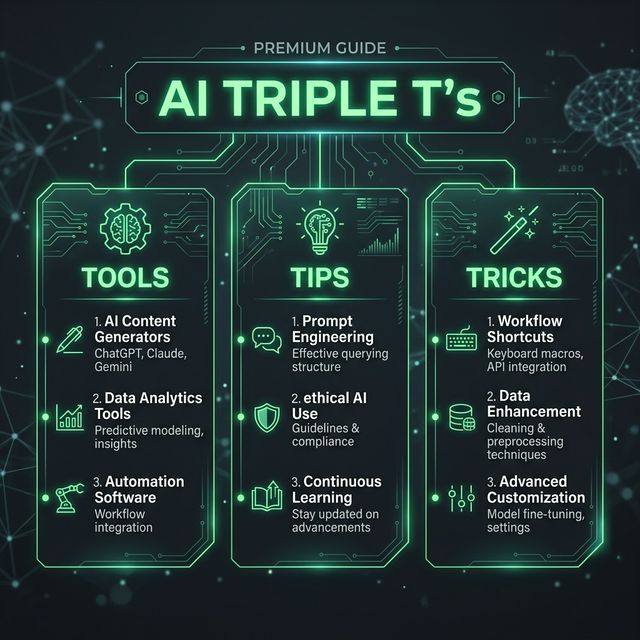
AI Triple T's: Master Vibe Coding and Natural Language Development
What You Need to Know First
Vibe coding is AI-first software development: You describe what you want in plain language, AI generates the code, and you refine through conversation. Coined by Andrej Karpathy in 2025 and named Collins Dictionary Word of the Year, it has been adopted by 92% of US developers. But here's the reality: Speed gains are real but come with trade-offs: 3-5x faster prototyping and 25-50% acceleration on routine tasks, but up to 45% of AI-generated code contains security vulnerabilities.
This isn't a free pass to skip thinking—it's about working smarter with AI as your collaborator.
TOOLS: The Essential Stack for 2026
1. Cursor — The Default IDE for Professional Developers
Cursor has become the default AI IDE for vibe coding. Its agent mode lets you describe a feature in natural language, and the AI will create files, edit existing code, run terminal commands, fix errors, and iterate -- all without you touching the keyboard. With a $29.3 billion valuation and $500M ARR achieved in under 3 years, it's the fastest-growing developer tool in history.
Why it matters: Multi-model support (Claude, GPT, Gemini) means you're never locked into one AI provider. For teams managing complex codebases, this is irreplaceable.
2. Windsurf (Codeium) — Best for Long Development Sessions
Windsurf (formerly Codeium) differentiates with Cascade, its multi-step agentic workflow that maintains context across interactions. It is especially strong for longer development sessions where you need the AI to remember decisions made earlier.
Why it matters: If you're refactoring legacy systems or building complex multi-file features, Cascade's context memory prevents the "AI amnesia" that plagues other tools.
3. Claude Code — The Deep Reasoner for Complex Architecture
Claude Code is a terminal-native agent with a 1 million token context window. That means it can hold your entire codebase in memory and reason about complex architectural decisions that stump other tools. It's the go-to choice for large-scale refactors, complex debugging, and projects where deep understanding of the codebase matters more than speed.
Why it matters: When your vibe coding gets stuck on architectural decisions, Claude Code's reasoning capabilities shine. It's your senior engineer in a terminal.
4. Lovable — From Zero to Full-Stack App in Minutes
Lovable quickly achieved $300 million in annualized revenue by January 2026, less than a year after its launch. It's particularly effective for design-focused React apps paired with Supabase backends. Lovable 2.0 adds Lovable Cloud (built-in backend with auth and data persistence), real-time collaboration for up to 20 users, agentic mode for multi-step autonomous edits, AI connectors (Perplexity, ElevenLabs, Firecrawl, Miro), visual CSS editing, themes, built-in analytics, and domain purchasing.
Why it matters: If your goal is shipping an MVP or prototype today, Lovable removes infrastructure complexity entirely.
5. Kiro — Spec-Driven Development (The Disciplined Approach)
Kiro is an agentic AI with an IDE and CLI that helps you go from prototype to production with spec-driven development. From simple to complex tasks, Kiro works alongside you to turn prompts into detailed specs, then into working code, docs, and tests—so what you build is exactly what you want and ready to share with your team.
Why it matters: Developing with specs keeps the fun of vibe coding, but fixes some of its limitations: vibe coding can require too much guidance on complex tasks or when building on top of large codebases, and it can misinterpret context. When implementing a task with vibe coding, it's difficult to keep track of all the decisions that were made along the way, and document them for your team.
TIPS: Pro Techniques for Effective Vibe Coding
Pro Tip #1: Use "Intent Parsing" — Separate Functional Intent from Vibe Descriptors
The developer writes a natural language prompt that describes the desired functionality and vibe. The Intent Parser processes this prompt, extracting functional requirements, vibe descriptors, and constraints.
How to use it: Instead of:
- ❌ "Make a playful auth form with dark mode"
Use:
- ✅ "Build a login form (functional intent) that feels approachable and fun with bright colors and friendly error messages (vibe). Requirements: TypeScript, React 18, no external auth libraries."
The more you separate what the app does from how it feels, the less you'll need to iterate.
Pro Tip #2: Create a GEMINI.md (or Style Guide) for Long-Term Memory
Expert tip: Create a GEMINI.md file in your project root. This file acts as "long-term memory," providing specific instructions, coding standards, and project goals that the AI follows at all times.
Practical example:
# Project Standards
- Framework: Next.js 15
- Database: PostgreSQL with Prisma ORM
- Auth: NextAuth v5
- Style: Tailwind CSS (dark mode required)
- Testing: Jest + React Testing Library
- Security: Never commit API keys; validate all inputs
This single file cuts down iteration loops by 60%+ because the AI remembers your constraints without you repeating them.
Pro Tip #3: Enforce "Vibe & Verify" — Don't Trust, Validate
The "Vibe & Verify" workflow relies on natural language prompts to generate code, followed by critical testing and refinement. Success now hinges on a developer's ability to evaluate AI outputs - deciding when to accept, tweak, or reject code - rather than just their programming skills.
Workflow that works:
- Generate code with your vibe coding tool
- Run it in a sandbox environment immediately
- Check for: security (no hardcoded secrets), performance (does it scale?), maintainability (can a colleague understand it?)
- Request unit tests from the AI for critical logic
- Deploy only after code review (yes, even for prototypes)
TRICKS: Real-World Use Cases You Can Try Right Now
Use Case #1: Build a Personal Task Manager MVP in 90 Minutes
The Setup:
- Tool: Lovable
- Time investment: 90 minutes
- Output: Production-ready MVP
The Prompt: "Create a personal task manager web app with:
- Dark mode UI (navy background, soft green accents)
- Task creation with due dates and priority levels
- Local storage (no backend needed)
- Friendly, encouraging tone in all UI text
- Mobile-responsive design Use React + Tailwind CSS. Make it feel calming and motivating."
What happens: Lovable generates a fully functional app you can share with stakeholders within 90 minutes. No infrastructure setup. No DevOps friction. Pure vibe-to-prototype speed.
Pro move: After getting the MVP, export the code and move it to Cursor for deeper customization if needed.
Use Case #2: Refactor Legacy Code with Architecture Context (Using Claude Code)
The Setup:
- Tool: Claude Code
- Challenge: You have 50,000 lines of Python that needs modernization
- Constraint: Team doesn't understand the original design
The Trick:
Provide Claude Code with:
- The entire legacy codebase (1M token window handles it)
- A README explaining what the system does
- A GOALS.md file explaining what you want to achieve
Ask for a detailed architecture analysis first:
"Analyze this codebase and explain:
- Current architecture and design patterns
- Technical debt hot spots
- Recommended refactoring path to migrate from X to Y
- Risk assessment for each phase
Do NOT generate code yet—just analysis."
After reviewing the analysis, request incremental refactoring:
"Refactor the user authentication module to use JWT instead of sessions.
Keep all existing tests passing. Generate the new code + updated tests."
Why this works: Claude Code's reasoning capabilities help you avoid the "AI hallucination" problem—it understands the why before generating the how.
The Real Security Talk
AI-generated code frequently contains vulnerabilities, and LLMs are prone to hallucinate nonexistent functions or misinterpret API usage. With proper guardrails — mandatory code review, automated testing, security scanning, and spec-driven tools like Kiro — vibe coding can produce production-quality code. Without review, it introduces security and quality risks.
Non-negotiables for production vibe coding:
- Run security scanners (Snyk, GitHub Advanced Security)
- Never hardcode secrets (use environment variables only)
- Write unit tests for every business-critical function
- Have a senior engineer review AI-generated code for auth/payments
The Bottom Line
Vibe coding isn't about "forgetting the code exists"—that's how you ship vulnerable, unmaintainable software. Vibe coding represents a fundamental shift from writing code to orchestrating AI agents. By adopting vibe coding best practices—such as providing rich context, iterating incrementally, and enforcing rigorous code review—you can drastically increase your development speed while maintaining high code quality.
The developers winning in 2026 aren't the ones trusting AI blindly. They're the ones treating AI as a pair programmer—powerful, fast, and occasionally wrong—and building safeguards accordingly.
Sources & References
- https://www.nxcode.io/resources/news/what-is-vibe-coding-complete-guide-ai-development-2026
- https://cloud.google.com/discover/what-is-vibe-coding
- https://daily.dev/blog/vibe-coding-how-ai-changing-developers-code
- https://www.niracore.com/top-vibe-coding-tools-ai-app-development-2026/
- https://en.wikipedia.org/wiki/Vibe_coding
- https://lushbinary.com/blog/vibe-coding-developer-guide-ai-first-development/
- https://qubittool.com/blog/vibe-coding-best-practices
- https://arxiv.org/html/2510.17842v1
- https://kiro.dev/