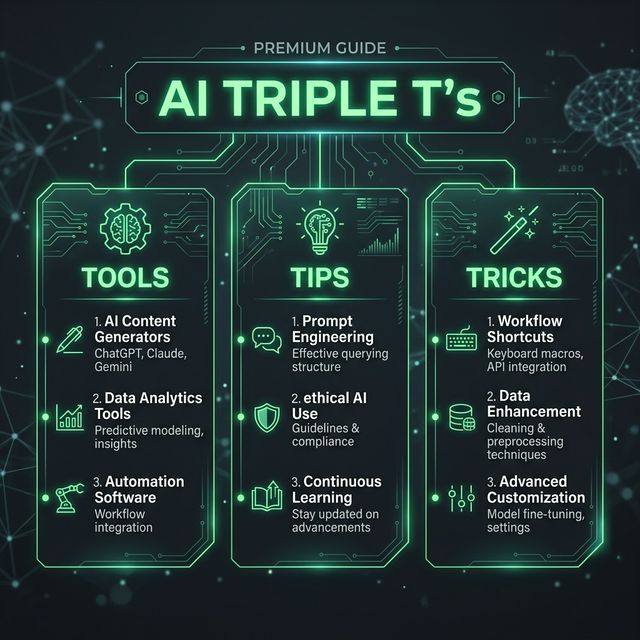
AI Triple T's: Claude Code + ChatGPT Mastery – 12 Killer Use Cases & Insider Tips for 2026
The New Pecking Order
Claude Code went from zero to being the #1 tool in only eight months, released in May 2025, and is already the most-used AI coding tool, overtaking GitHub Copilot and Cursor. Meanwhile, ChatGPT remains the dominant conversational AI platform with browsing capabilities and enterprise integrations, functioning as a synthesis layer for information retrieval.
But here's what matters: Most engineers juggle two to four tools at once. The real productivity spike doesn't come from picking one winner—it comes from understanding when and how to use each tool for its specific strength.
Part 1: TOOLS – The Architecture That Works
The Unstoppable Trio
The Trinity Stack for 2026:
Claude Code – Claude Code leads the pack, followed by chatbots and GitHub Copilot.
- Best for: Deep refactoring, multi-file context, architecture decisions
- Context window: 1M context window (beta), a first for Opus-class models with 128K output
- Who loves it: Tiny startups mostly go with Claude Code (75%) and Cursor (42%)
ChatGPT – ChatGPT is the current industry leader, and the first chatbot that set the scene on fire—and it's surprisingly flexible and very easy to use.
- Best for: Research synthesis, document analysis, strategic brainstorming
- Integration superpower: The tool is particularly good at document analysis—through the chat interface, you can upload PDFs, spreadsheets, screenshots, and other files. ChatGPT also connects easily to other tools from OpenAI, for example, Sora 2 which is an AI video generating tool.
Perplexity – The citation layer
- Perplexity delivers cited answers from an average of 42 sources within minutes.
- For teams doing research: If your primary use case is answering factual questions with sources you can verify, Perplexity is far more reliable than any general chatbot.
Second-Tier Specialization Tools
Workflow Accelerators:
- NotebookLM – to answer questions using your own documents.
- ElevenLabs – to generate realistic voices, text-to-speech, and voice agents.
- Gamma – to convert notes into presentations, documents, and webpages.
- Fathom – to record meetings and create summaries and action items.
This guide breaks down nine of the best AI productivity tools across six workflow categories: meetings, research, writing, scheduling, automation, and building.
Part 2: TIPS – Smart Deployment Strategies
Tip 1: The "Document First" Approach for Research
Stop asking ChatGPT vague questions.
What works: Upload your source material first (PDFs, CSVs, whitepapers), then ask contextual questions.
Through the chat interface, you can upload PDFs, spreadsheets, screenshots, and other files, and ask it to summarize insights or highlight trends in data.
Pro move: If you need cited sources, cross-hand to Perplexity after ChatGPT does the synthesis. Content must be clearly structured, authoritative, and citation-ready to appear in AI-generated responses.
Tip 2: Code Context Matters More Than Model Size
Windsurf's codebase context management is excellent on medium-sized projects but showed some drift on repos with over 500 files in testing. Cursor's custom .cursorrules still gives more precise control when you need it. But for most developers building typical SaaS products or APIs, Windsurf's combination of features at this price is hard to argue against.
Translation: Before switching AI coding tools, audit your codebase size. If you're under 500 files, any tool works. If you're over 500, context management > raw capability.
Tip 3: Don't Use Reasoning Models for Creative Work
Don't use reasoning models for creative writing or brand voice content. Their training makes them "Spock-like", hyper-logical but lacking narrative fluency. They also have narrower knowledge breadth than general-purpose models; a pop culture reference or recent industry trend might draw a blank or require explicit context.
Action: Use Claude for brand voice + long-form prose. Reserve reasoning models (o1/o3 style) for logic-heavy tasks only.
Tip 4: The "Workflow Friction Audit"
Don't pick tools based on hype. Start with your workflow pain points. Match tools to problems. Test before committing to paid tiers. The most effective productivity stack removes friction from your specific workflow, not the one with the longest feature list.
Template:
- Where does your team lose 3+ hours per week?
- Which repetitive task makes people groan?
- Can it be solved by a standalone tool or does it need ecosystem integration?
Tip 5: Integration Beats Capability
AI tools are great at individual tasks, but the real magic happens when you can connect them together. In fact, 78% of enterprises are struggling to integrate AI with their current tech stacks.
Fix it: Use Zapier as your orchestration layer. Zapier connects thousands of apps through automated workflows called Zaps. The platform offers AI-powered features including Copilot for building automations and MCP for advanced orchestration. When something happens in one app, Zapier triggers actions in others, no coding required. Recent updates bundled Tables, Interfaces, and Zapier MCP into standard plans at no extra cost. The AI Copilot helps build automations through conversation rather than clicking through configuration screens.
Part 3: TRICKS – 12 Power Moves You're Missing
For Content Creators
Trick #1: The "Chat-to-Presentation" Pipeline
- Research in ChatGPT (document upload mode)
- Brainstorm outline with Claude
- Convert to presentation slides with Gamma – to convert notes into presentations, documents, and webpages.
- Refine visuals with Canva AI
Expected time savings: 6 hours → 45 minutes per deck
Trick #2: Multi-Language Content at Scale
HeyGen lets you take an existing video and translate it into multiple languages while keeping the original speaker's voice, tone, and even lip sync intact. No reshoots. No awkward dubbed audio. Just the same video, adapted for different regions and audiences.
Real ROI: Forever 21 reported a 66% ROI uptick from generative-first campaigns.
Trick #3: Voice Agents for Customer Ops
ElevenLabs – to generate realistic voices, text-to-speech, and voice agents.
Use case: Build a voice bot that handles FAQs using your company's tone. Route complex issues to humans. Zero coding required.
For Developers
Trick #4: The "Code Review Swap" Pattern
Don't ask Claude to write code from scratch (it's slower). Instead:
- Write messy first draft (5 min)
- Paste into Claude Code with context
- Ask: "Refactor this for [readability/performance/security]"
- Review the diff, merge if good
Time delta: Writing from prompt (25 min) vs. refactoring messy code (8 min)
Trick #5: Cost Optimization for LLM-Heavy Products
Zhipu AI released GLM-5 under the MIT License, fully self-hostable, with API pricing set at $1.00 input / $3.20 output per million tokens. Compare that to GPT-5.4 at roughly $15/$60 per million tokens. GLM-5 gives you frontier-level open-source performance at one-fifteenth the cost for some workloads.
Action: If your product does high-volume inference, run A/B tests with GLM-5 for commodity tasks. Save Claude/GPT for high-stakes reasoning.
Trick #6: Autonomous Multi-Step Workflows
55% of respondents now regularly use AI agents, with staff+ engineers leading adoption on 63.5% usage. Agent users are twice as excited about AI as non-users are.
Next move: Build agents that execute multi-step tasks without human intervention. Example: PR review agent that lints code → runs tests → suggests improvements → tags reviewers.
For Knowledge Workers
Trick #7: The "Perception Stack" for Meetings
CraftNote is an AI meeting assistant that transcribes audio in 100+ languages, identifies speakers with persistent memory, and generates actionable summaries. It works offline for in-person meetings and integrates with CRMs like Salesforce and HubSpot.
Bonus: It doesn't just generate simple meeting notes; it also highlights the sentiment in your meeting transcripts. This can help you gauge whether a customer was engaged in the conversation and what their overall feeling toward your product was.
Trick #8: The "Cascade" Strategy for Long Documents
Claude handles deep document analysis and complex reasoning. For writing friction: Grammarly catches errors and polishes tone. Claude generates and iterates on longer content.
Pattern:
- Draft → Grammarly polish → Claude expansion → Final review
- Long documents (3,000+ words) sometimes lose coherence in the second half unless you generate in sections.
Trick #9: Brand-Safe Content at Scale
Where other LLMs tread gray areas, Writer offers their proprietary LLMs and plenty of tools to make sure your content stays true. Writer will help keep brand voice consistent for teams who collaborate on publishing. By connecting Writer with Zapier, you can embed brand-safe AI writing into your company's workflows at scale. When your marketing team drafts a campaign brief, you can have AI generate channel-specific copy, applying your company's brand guidelines and style rules automatically. It can also route the content to legal for approval, translate it for regional markets, and then push the final assets into your publishing and project management tools.
For Product Builders
Trick #10: The "No-Code Prototype Sprint"
App builders represent the most transformative category in AI tools -- they let non-developers ship real software. The quality of generated apps has improved dramatically in 2026.
Tooling: Lovable – to build simple web apps from simple prompts.
Workflow:
- Describe app idea in plain English
- Lovable generates full-stack app (frontend + backend + DB)
- You own the code (export it, modify it, host anywhere)
- Iterate with AI prompts or hand-edit
Timeline: Idea to MVP = 2 days instead of 2 weeks
Trick #11: The "Citation Check" Pattern for Fact-Heavy Content
Never publish without running through this loop:
- Draft with Claude or ChatGPT
- Cross-check facts with Perplexity
- Verify sources are real and recent
- Flag any AI hallucinations
Why it matters: Hallucinations are one of the biggest issues with AI. To counter this risk, some tools build web searches into their apps, using the results as sources to support the AI-generated answer. And that's an AI search engine in a nutshell.
Trick #12: The "AI Literacy Audit" for Teams
Tools like Cursor and n8n require a higher technical threshold than simple chatbots. Invest in AI Literacy Training to ensure adoption.
Mapping your team:
- Tier 1 (Anyone): ChatGPT, Gamma, Canva AI
- Tier 2 (Some training needed): Claude, Perplexity, Zapier
- Tier 3 (Engineers only): Claude Code, Cursor, n8n
Don't buy tier-3 tools for tier-1 users. It's a waste.
The Real Competitive Edge in 2026
In 2026, high-performing marketing teams operate as: Human strategic oversight + AI execution acceleration. AI handles scale. Humans handle context.
If 2023 was the year AI learned to talk, 2026 might be the year it learned to act. The report highlights the rise of AI agents—systems capable of executing complex, multi-step tasks across apps and workflows.
The teams winning in 2026 aren't using better AI models. They're orchestrating better workflows.
Start today: Pick one friction point in your workflow, match it to one tool, test it for 7 days. Then chain it to your next tool. Build your stack intentionally.
The signal-to-noise ratio matters more than the size of the model.
Sources & References
[1] - "AI Tooling for Software Engineers in 2026" | The Pragmatic Engineer
[2] - "AI dev tool power rankings & comparison [March 2026]" | LogRocket Blog
[3] - "The Best AI Tools for 2026" | Medium - Artificial Corner
[4] - "The 12 Best AI Tools for 2026 (That People Actually Use)" | Synthesia
[5] - "Top 10 AI Tools for 2026" | DataNorth AI
[6] - "The best AI productivity tools in 2026" | Zapier
[7] - "Best AI Tools 2026: Complete Ranking Across Every Category" | NxCode
[8] - "Best AI Productivity Tools 2026: 9 Game-Changing Apps" | Lovable
[9] - "7 AI Tools That Changed Developer Workflow (March 2026)" | Build Fast with AI
[10] - "Best AI productivity tools (2026): 20 tools to help you work smarter, not harder" | Plus
[11] - "Best AI Productivity Tools for 2026: 19 Tools Ranked by Business Function" | Alai Blog
[12] - "AI Productivity Tools: We Tested The Best Ones in 2026" | CraftNote
[13] - "The 100 Most Used AI Tools in 2026 Reveal a Power Shift Big Tech Didn't See Coming" | UC Strategies
[14] - "Best AI Writing Tools 2026" | ToolCenter