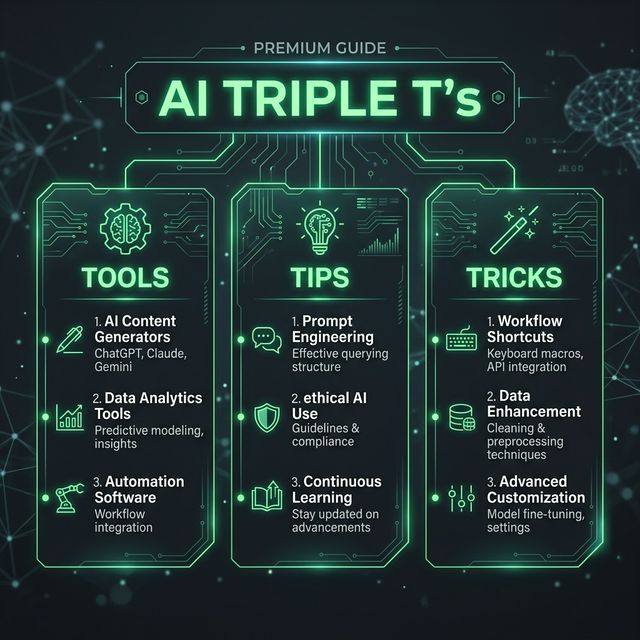
AI Triple T's: Mastering AI for Social Media Management and Growth
The AI Social Media Reality in 2026
In 2026, 85% of businesses are using AI for social media automation, a dramatic increase from 42% in 2023. According to HubSpot's State of Marketing Report, marketers using AI tools save an average of 2.5 hours per day on content creation tasks. But raw tools aren't enough—you need strategy.
The Tools (Curated for 2026)
1. Hootsuite – The Intelligent All-In-One Platform
Hootsuite is a social media management tool that brings scheduling, content creation, analytics, and social listening to one place. What makes it powerful in 2026 isn't just breadth—it's depth.
Unique value: View hot topics by industry and then have AI instantly draft posts based on those trends. Hootsuite includes AI scheduling suggestions that predict the best times to post based on your audience behavior.
Best for: Enterprises, agencies managing multiple accounts, teams needing social listening at scale.
2. Supergrow – The LinkedIn-First Growth Engine
What sets Supergrow apart from most AI tools for social media content creation is its focus on consistency and outcomes. The platform is designed for founders, marketers, and B2B teams who want to build visibility, authority, and inbound demand on LinkedIn without relying on risky automations or generic AI output.
Unique value: LinkedIn-first scheduling with auto-commenting: Publish posts and schedule first comments to maximise early engagement. AI-assisted comments for engagement: Generate context-aware comments to stay active and visible without sounding robotic.
Best for: B2B founders, LinkedIn-focused marketers, agencies managing professional growth strategies.
3. Eclincher – AI Agents for Execution
Eclincher is an all-in-one platform that stands out for its advanced AI agents handling auto-posting and auto-replies. It features a unified inbox for over 20 channels, smart content queues, integrated brand monitoring, and a unique local SEO automation feature.
Unique value: It's the only tool on this list that combines social media automation with local search visibility management, a significant advantage for businesses that rely on Google Maps and local discovery.
Best for: Local businesses, multi-location brands, teams needing unified channel management.
4. Canva – Visual Content at Scale
Use AI to generate social media posts in seconds, so you never run out of content. Automatically add relevant hashtags and emojis to make your posts more engaging, or repurpose your blogs, videos, or newsletters into social-ready posts without starting from scratch.
Unique value: Magic Design & AI tools: Instantly generate custom social posts, graphics, and presentations from a simple text prompt, leveraging AI for layout, imagery, and copy suggestions.
Best for: Visual-first creators, small teams, anyone needing fast, on-brand design without a learning curve.
5. SocialBee – The Smart Content Strategist
SocialBee's AI-powered social media post generator streamlines content creation by offering more than 1,000 customizable prompts. It enables users to generate engaging captions and images tailored to their brand's voice across various platforms.
Unique value: Social Bee's CoPilot tool makes strategizing for social media easy. With the free trial, CoPilot asked a series of questions to understand my business goals. Based on my input, CoPilot guided me through connecting my preferred social channels, recommended optimal content formats, and generated a posting schedule focused on my target clients.
Best for: Solopreneurs, small business owners, teams building content strategy from scratch.
The Pro Tips (Tested Strategies for Real Results)
Tip #1: Build a Multi-Tool Workflow, Not a Single Platform
Think in workflows, not just tools: The most efficient social media managers use a few specialized tools that work well together. For example, you could use the eesel AI blog writer to generate a cornerstone article, jump over to Canva to create graphics for it, and then use Buffer to schedule a month's worth of promotional posts.
The reality: One tool rarely does everything well. Instead, chain tools together: content ideation (ChatGPT/Claude) → copy refinement (Jasper) → visual creation (Canva) → scheduling (Buffer/Hootsuite) → analysis (native platform analytics).
Tip #2: Use AI for Drafts, Not Final Content
Like every AI drafting tool, the output is a starting point. My voice, my specific examples, my lived experience — that's what I add in the edit. If I publish the AI variation as-is, my audience will feel it.
Actionable approach: Instead of agonizing over the "perfect" first draft, give it a rough concept and let it generate five different takes. Then "Frankenstein" the best parts together — the hook from version 2, the framing from version 4, your own closing line. It sounds messy, but it's significantly faster than writing one perfect post from scratch.
Tip #3: Prioritize Social Listening Over Automated Posting
One of the most impactful ways of using AI for social media marketing is social listening. Sprout Social Listening enables in-depth consumer research, trend discovery, campaign analysis and industry benchmarking. It also helps spot market gaps and understand competitor strategies through side-by-side comparisons of metrics like share of voice, engagement and impressions.
Why it matters: You can use AI to turn trending keywords from your social listening tool into on-brand post ideas, complete with platform-specific copy. Trend-aware content beats the algorithmic squeeze every time.
The Tricks (Two Immediate Use Cases)
Use Case #1: "Rapid Content Multiplication" for LinkedIn B2B Growth
The setup:
- Write one flagship LinkedIn article or insight (600 words)
- Feed it into Supergrow's carousel generator
- Create 5-7 variations: quote posts, thread formats, short captions
- Use auto-commenting feature to engage on day one
- Measure engagement and repurpose top performers
The result: LinkedIn analytics and engagement insights: Understand what formats and topics drive reach, interaction, and consistency. One piece of thinking becomes a week of content—with authentic engagement baked in.
Use Case #2: "Trend-Capture Workflow" for Cross-Platform Growth
The workflow:
- Set Hootsuite to monitor trending topics in your niche (hourly)
- When a trend hits, trigger a Zapier workflow that:
- Sends the trend to ChatGPT with your brand guidelines
- Generates 3 platform-specific post variants
- Creates visuals via Canva API
- SocialBee's CoPilot approves and schedules across channels
- Eclincher auto-comments on related brand mentions
Why it works: In 2026, social platforms reward relevance, speed, consistency, and native-feeling content. Trend-first wins over evergreen-only strategies—and AI makes speed possible at scale.
The Bottom Line
The best AI social media automation tools in 2026 go far beyond scheduling — they write content, monitor trends, manage engagement, and report on performance. But they're only as good as your strategy. The teams winning in 2026 aren't throwing more posts at the wall—they're using AI to think faster, test smarter, and listen harder.
Start with one of the five tools above. Build your workflow. Layer in social listening. Let AI handle the drafts. Your voice handles the rest.
Key Takeaway: SBT implemented AI-powered automation and achieved a 25% increase in daily clicks and 61% rise in organic impressions, while saving 14 hours per day through automated posting. Similarly, Salesforce's social media team saved 12,000 hours annually and improved efficiency by 10x using automation across 150+ social channels. These aren't outliers—they're proof that AI works when you use it right.